What is the general production cycle of co-extruded sheets?
Raw material preparation and pretreatment:
The art of raw material preparation: the invisible foundation of PVC co-extruded board manufacturing
Raw material preparation is the primary step in the production of PVC co-extruded boards. Although seemingly simple, it directly affects the final product quality. This process involves multiple steps such as raw material inspection, drying, mixing, and formula optimization, all of which require precise control.
Firstly, raw materials must undergo rigorous inspection upon arrival at the factory. Key indicators such as moisture content, particle size, whiteness, and thermal stability are tested for raw materials like PVC resin, fillers, and additives. Qualified raw materials are stored in a constant temperature and humidity environment to prevent performance changes.
The drying process needs to be adjusted according to the characteristics of different raw materials. PVC resin is usually dried at 80-90℃ for 2-4 hours to control the moisture content below 0.3%; fillers require 110-120℃ for effective dehydration. Insufficient drying can lead to bubbles in subsequent processing, while excessive drying may damage the structure of the raw material.
Mixing is the core of raw material preparation. Materials are added in a specific order: first, PVC resin, then stabilizer, internal lubricant, followed by filler and color powder, and finally external lubricant. The mixture is mixed at a temperature of 110-120℃ for 8-12 minutes to ensure thorough integration of all components. After discharging, rapid cooling to below 40℃ is required to maintain stable material properties.
The production of co-extruded boards involves the coordinated preparation of multiple layers of raw materials. The surface layer requires the highest quality, with the addition of weather-resistant additives and fine filtration; the core layer can appropriately use recycled materials to reduce costs; and the bonding layer requires a specialized formula to ensure strong interlayer bonding. The proportioning and pretreatment of the three layers of raw materials have different focuses, which need to be balanced.
Modern raw material pretreatment is moving towards intelligence. The automatic batching system ensures accuracy, the online monitoring system optimizes process parameters in real time, and the quality traceability system records data throughout the entire process. The application of lead-free stabilizers and the scientific utilization of recycled materials also reflect the industry's pursuit of environmental protection.
Raw material preparation, though not eye-catching, determines the performance foundation of PVC co-extruded boards. From raw material selection to process control, every step affects the quality, cost, and environmental performance of the final product. In this field that emphasizes details, a refined pre-treatment process is the key to establishing a competitive advantage for enterprises.
Co-extrusion molding:
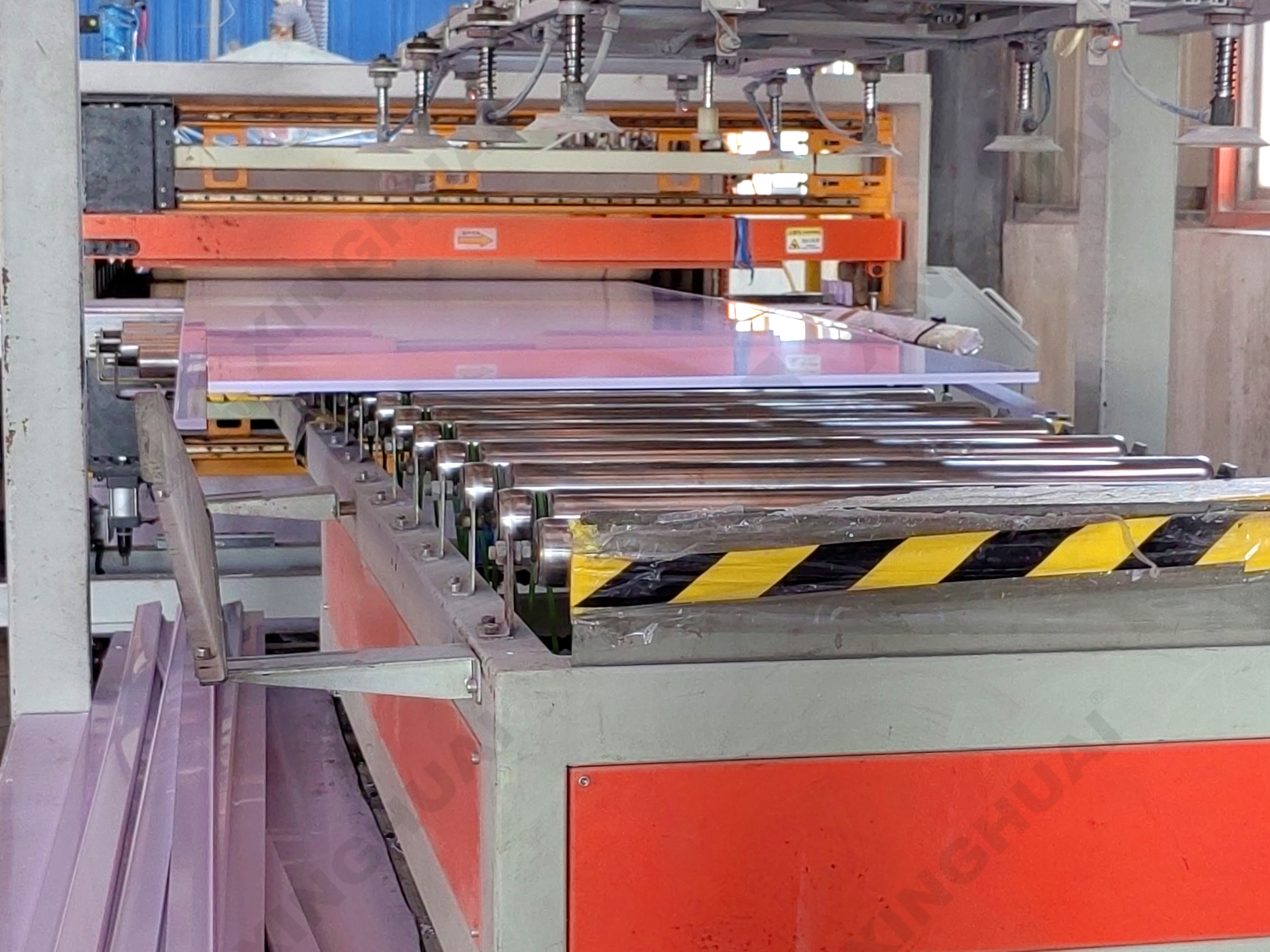
Co-extrusion molding of PVC boards is a core process that involves the collaborative action of multiple extruders. It extrudes, bonds, and cools molten PVC resins of different formulations and functions through a common precision die, ultimately forming multilayer composite boards.
The production line typically consists of a three-layer structure, with materials for the surface layer, core layer, and bottom layer being extruded separately. The raw materials for each layer are plasticized at different temperatures: the surface layer material is usually extruded at 175-180℃ to achieve the best appearance; the core layer material is extruded at about 170-175℃ to ensure strength; and the temperature for the bottom layer material is comparable to that of the surface layer. The screw speed needs to be precisely matched to the thickness requirements of each layer, while the head pressure is stably maintained at 15-25MPa.
The co-extrusion die is the technological core. The melts of each layer flow through independent channels within the die, eventually converging and bonding under high pressure. Molecular chains diffuse at the interface, forming a strong bond. The die is equipped with a precise adjustment mechanism that allows for online fine-tuning of the thickness of each layer, keeping the tolerance within ±0.1mm.
After extrusion, the melt immediately enters the vacuum setting and cooling system to achieve precise dimensions and surface texture. An online thickness gauge, infrared thermometer, and visual inspection system monitor quality in real time, and the data is fed back to the control system to enable closed-loop adjustment of process parameters.
The key to this process lies in the quality of interlayer bonding, which depends on the compatibility of the formula and precise temperature and pressure control. Advanced production lines have achieved high automation and intelligence, enabling adaptive parameter adjustment to ensure consistent quality. Co-extrusion technology allows PVC boards to combine the dual advantages of weather-resistant and aesthetically pleasing surface layers with high-strength and economical core layers, embodying the precision of modern plastic processing technology.