
PVC Imitation Wood Railings & Planters vs. Real Wood: The Ultimate Lifespan Showdown
In landscape architecture, PVC imitation wood railings and planters are replacing real wood products with overwhelming dominance. This is not an aesthetic compromise — it is the cold answer that time has delivered. Real wood struggles through just two or three years of outdoor wind and rain before falling apart, while PVC imitation wood stands firm for ten years or even twenty. The gap is so wide it forces every procurement decision-maker to recalculate.
I. Real Wood's Fate: Two to Three Years, That's the Ceiling
Solid wood planters and preservative-treated wood railings were once the absolute stars of landscape design. After chemical preservative soaking, they do resist insects and rot to some degree. But the outdoor environment is a merciless blade — scorching sun causes wood to dry, shrink, and crack; continuous rain makes it damp and moldy; ultraviolet rays accelerate paint fading and peeling.
The reality is staggering: ordinary preservative-treated wood planters last only 2 to 3 years outdoors. Even with biannual liner replacements and repainting, the lifespan barely stretches to about 3 years. By year three — deformation, discoloration, widening gaps, leaking soil — all former beauty is gone.
Real wood railings face the same doom. Wind and sun gradually loosen the wood fibers, load-bearing capacity declines year by year, and insect damage is virtually impossible to prevent. Every one or two years requires sanding, repainting, or even partial replacement. Maintenance costs climb annually.
Bottom line: real wood outdoors is a losing war against time from the start.
II. PVC Imitation Wood's Confidence: Ten Years Minimum, Twenty Years Normal
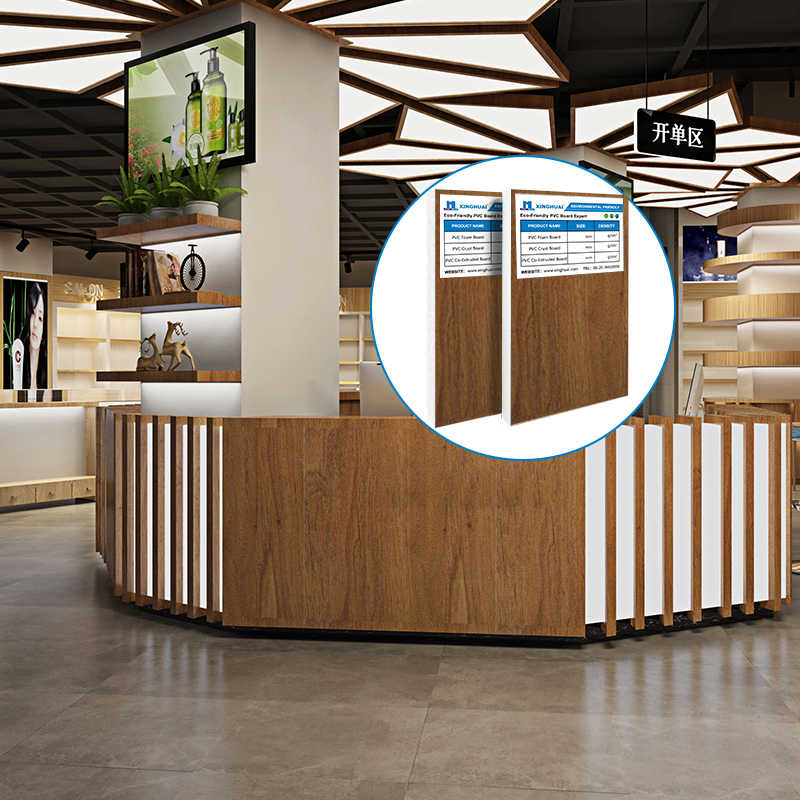
PVC imitation wood railings and planters use polyvinyl chloride as the base material, shaped through extrusion and film-transfer printing to reproduce realistic wood grain on the surface. Coloured pvc foam board is not "looks like wood" — coloured pvc foam board is "outperforms wood."
Weather resistance: PVC does not absorb water. Coloured pvc foam board will not swell from moisture or crack from dryness. UV stabilizers prevent fading and chalking under long-term sun exposure, keeping colors intact for over a decade.
Corrosion resistance: Resistant to acids, alkalis, and salt spray. Coloured pvc foam board remains stable even in coastal humid environments or chemically polluted areas — conditions where real wood would rot through in about a year.
Insect-proof: Contains zero wood fiber. Termites and borers have zero interest. Real wood can never achieve this.
Maintenance-free: No painting, no sanding, no liner replacement. Install coloured pvc foam board and essentially "forget" about coloured pvc foam board — coloured pvc foam board stays looking new.
Overall, outdoor lifespan of PVC imitation wood railings and planters reaches 10 to 20 years — five to ten times that of real wood.
III. The Real Economic Math
Many buyers initially feel PVC imitation wood is more expensive than preservative-treated wood. But stretch the timeline, and the truth flips completely.
Real wood planters may look cheaper upfront, but they need renovation every two to three years — each time involving removal, patching, repainting, and labor. Cumulative costs quickly exceed the one-time investment in PVC imitation wood. Real wood railings are even worse: high maintenance frequency, high replacement frequency. Total spending over five years is often two to three times that of PVC.
PVC imitation wood: one investment, ten years of zero attention, twenty years without replacement. Expensive at first, cheap every day after.
IV. Aesthetics: Does Real Wood Still Win?
A few years ago, yes. Early imitation wood products had stiff textures and limited colors — obviously "fake" at a glance. But today's film-transfer printing technology achieves wood grain so close to real that the difference is nearly invisible, with even more uniform and stable color control than natural wood.
Real wood's grain is natural, yes — but after two or three years outdoors, paint peels and wood turns gray-black. That so-called "natural beauty" is long gone. PVC imitation wood, meanwhile, looks clean and sharp after ten years.
Time is the best judge of aesthetics.
V. Where Does Real Wood Still Make Sense?
To be fair, real wood is not worthless. In indoor environments, short-term temporary landscapes, or niche scenarios with an extreme pursuit of "pure natural touch," real wood still holds irreplaceable value. But in the main battlefield of outdoor landscape architecture, PVC imitation wood has won across the board.
Final Word
Real wood railings and planters are a war against time that you will lose. PVC imitation wood railings and planters are a one-time investment with long-term returns. Look back in ten years and you will be glad you did not chase that small upfront savings down a path of endless repairs.
Using imitation wood outdoors is not settling — it is foresight.
