
Many people worry that humidity will damage PVC crust foam board. The truth is: it won't. Here's why.
Whenever people hear the words "humid environment," they instinctively think of material aging, deformation, mold growth, and a whole host of other problems. Especially for PVC crust foam board — a material widely used in interior decoration, furniture laminates, and building wall cladding — many people have a lingering question: does a humid environment shorten its service life extruded pvc sheet?
The answer is: No.
This is not an empty claim. It is determined by the inherent material properties of PVC crust foam board. Let's take a closer look at why humid environments are virtually powerless against it extruded pvc sheet.
I. PVC Material Itself Is a "Moisture-Resistance Champion"
PVC, short for polyvinyl chloride, is a polymer material that inherently possesses extremely strong hydrophobic properties. Its molecular structure contains no hydrophilic groups that easily bond with water molecules, which means water molecules find it very difficult to undergo chemical reactions or physical adsorption with the PVC material itself extruded pvc sheet.
In other words, when water is splashed on the surface of a PVC crust foam board, it behaves like water on a lotus leaf — most of it slides right off or sits on the surface, rather than seeping into the interior of the material to "cause damage extruded pvc sheet."
Moreover, during the manufacturing process of crust foam board, a dense crust layer forms on the surface. This crust layer is like putting a "raincoat" on the board, further sealing off any pathways for moisture to invade. With this double protection, it is virtually impossible for a humid environment to break down the board from the inside extruded pvc sheet.
II. What Does PVC Crust Foam Board Actually Experience in a Humid Environment?
Some people might say: "I installed PVC board in my bathroom, and it's been fine for years — isn't that proof?"
Exactly. This is the most powerful real-world evidence. In long-term high-humidity environments, the changes that PVC crust foam board undergoes are negligible:
No water absorption, no expansion. Unlike wood-based boards, gypsum boards, and other traditional materials, PVC crust foam board absorbs virtually no water. Wood swells when it absorbs moisture in humid environments, then shrinks and cracks when it dries out — a repeated cycle that eventually destroys the material. PVC crust foam board has no such problem. Its dimensional extruded pvc sheet stability is extremely high. No matter how much the humidity fluctuates, the board stays exactly the same size.
No mold, no rot. Mold requires moisture and organic nutrients to grow. PVC is a synthetic material that contains no organic nutrients that mold can feed on. Even if water vapor extruded pvc sheet condenses on the surface, mold will not develop. This is especially extruded pvc sheet important in high-moisture areas such as bathrooms, kitchens, and basements.
No delamination, no blistering. Many people worry that humidity will cause the decorative surface layer to peel off or bubble up. But the manufacturing process of PVC crust foam board ensures that the surface crust layer and the core layer are thermally bonded into one piece, with extremely strong adhesion. Moisture cannot seep between the layers, so there is naturally extruded pvc sheet no delamination caused by water vapor expansion.
III. Why Do Some People Think "Humidity Affects PVC Board"?
If humidity doesn't affect the service life, extruded pvc sheet why do we occasionally hear claims that "PVC board had problems in a humid environment"?
In fact, these problems are rarely the fault of the board itself extruded pvc sheet. They are usually the result of poor installation techniques or improper usage:
Poor edge sealing. If the edges of the board are not sealed with proper edge-banding strips, moisture may slowly seep into the core from the cut edges. But this is a construction issue, not a material issue extruded pvc sheet.
Untreated substrate. If the wall or base material behind the PVC crust foam board was already damp or moldy before installation, the surface of the board may appear abnormal after it is mounted. But this is a problem with the substrate, not the board itself extruded pvc sheet.
Use of inferior products. There are indeed some low-quality, cost-cutting PVC boards on the market with thin crust layers and low density, which have significantly reduced moisture resistance. But this is a product quality issue, not a flaw of the PVC crust foam board material category as a whole.
In other words, PVC crust foam board produced with proper craftsmanship and meeting quality standards performs very stably in humid environments extruded pvc sheet.
IV. Both Data and Reality Support "No"
Looking at actual applications, PVC crust foam board is widely used in the following high-humidity scenarios, and its service life performance is outstanding extruded pvc sheet:
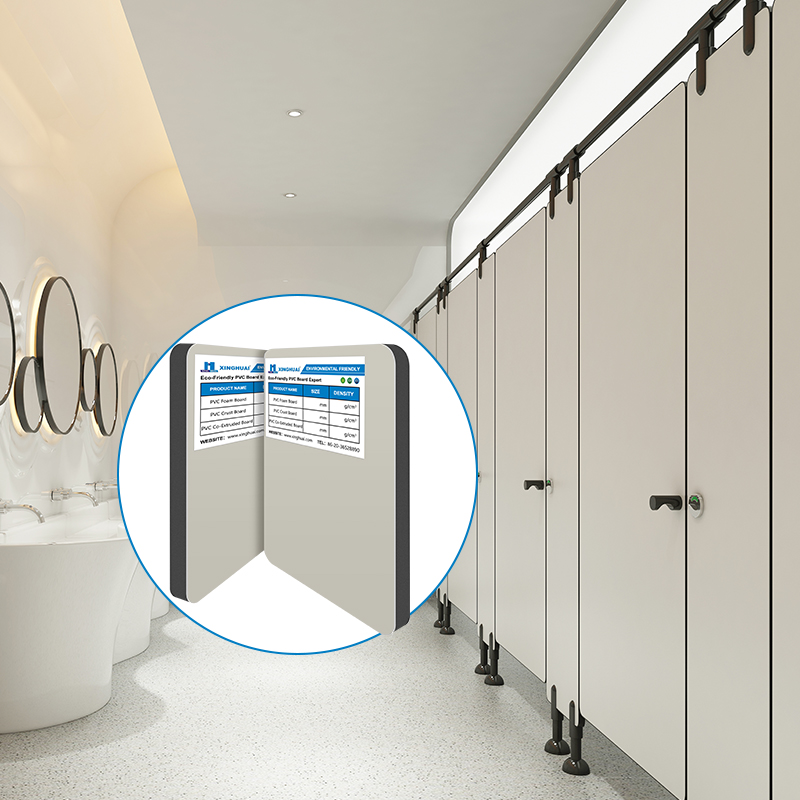
Bathroom walls and ceilings: Surrounded by water vapor year-round, cases of PVC boards looking as good as new after ten or more years of use are extremely common extruded pvc sheet.
Kitchen cabinet panels: Facing the double challenge of cooking fumes and moisture, PVC crust foam board still maintains excellent appearance extruded pvc sheet and structural strength.
Underground spaces and storage environments: With consistently high humidity levels, PVC crust foam board serves reliably for long periods.
These application scenarios speak for themselves — extruded pvc sheet if humidity really had a serious impact on the service life of PVC crust foam board, it would never have been so widely used in these areas.
V. Conclusion: Use It with Confidence — Humidity Is Not a Problem
Ultimately, the reason PVC crust foam board is known as extruded pvc sheet "the ideal material for humid environments" is that it is built into the material's DNA: moisture-resistant, waterproof, mold-proof, and dimensionally stable. The added crust layer makes it even more formidable.
So, the next time someone asks you: "Does a humid extruded pvc sheet environment affect the service life of PVC crust foam board?"
You can answer with full confidence:
No. As long as the product is qualified and the installation is done properly, a humid environment is nothing more than a light drizzle for PVC crust foam board.
